Best Soil for Balcony Gardens and Container Plants
Choosing the right container is important.
But what you put inside that container matters just as much.
After growing vegetables, fruits, herbs, and ornamental plants on my rooftop terrace for years, I have learned that good container soil needs to do several jobs at the same time.
It must:
- hold enough moisture,
- drain excess water,
- provide air around the roots,
- support the plant,
- and contain or receive enough nutrients.
Ordinary soil from the garden often does not do all of these things well inside a container.
For balcony and rooftop gardening, a good potting mix is usually a much better starting point.
You also do not need one complicated recipe for every plant.
For most plants, I start with a good-quality general potting mix and adjust it when a plant has special needs.
Start With Good Potting Mix, Not Garden Soil
One of the easiest mistakes to make as a beginner is filling containers with ordinary soil taken from the garden.
It may look perfectly good in the ground.
Inside a container, however, it behaves differently.
Garden soil can become:
- heavy,
- compacted,
- poorly aerated,
- slow to drain.
Containers have limited space.
Roots cannot simply grow farther away when conditions become poor.
That is why I prefer commercial potting soil or container growing mix as the main ingredient.
It is designed to remain lighter and more open than ordinary garden soil.
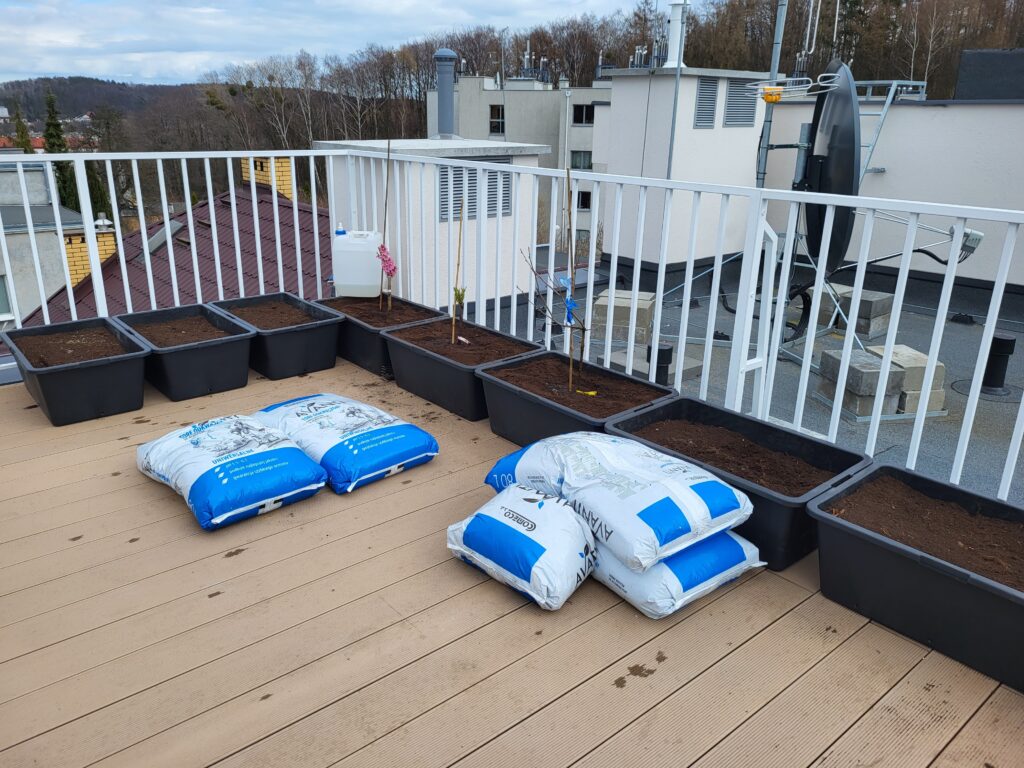
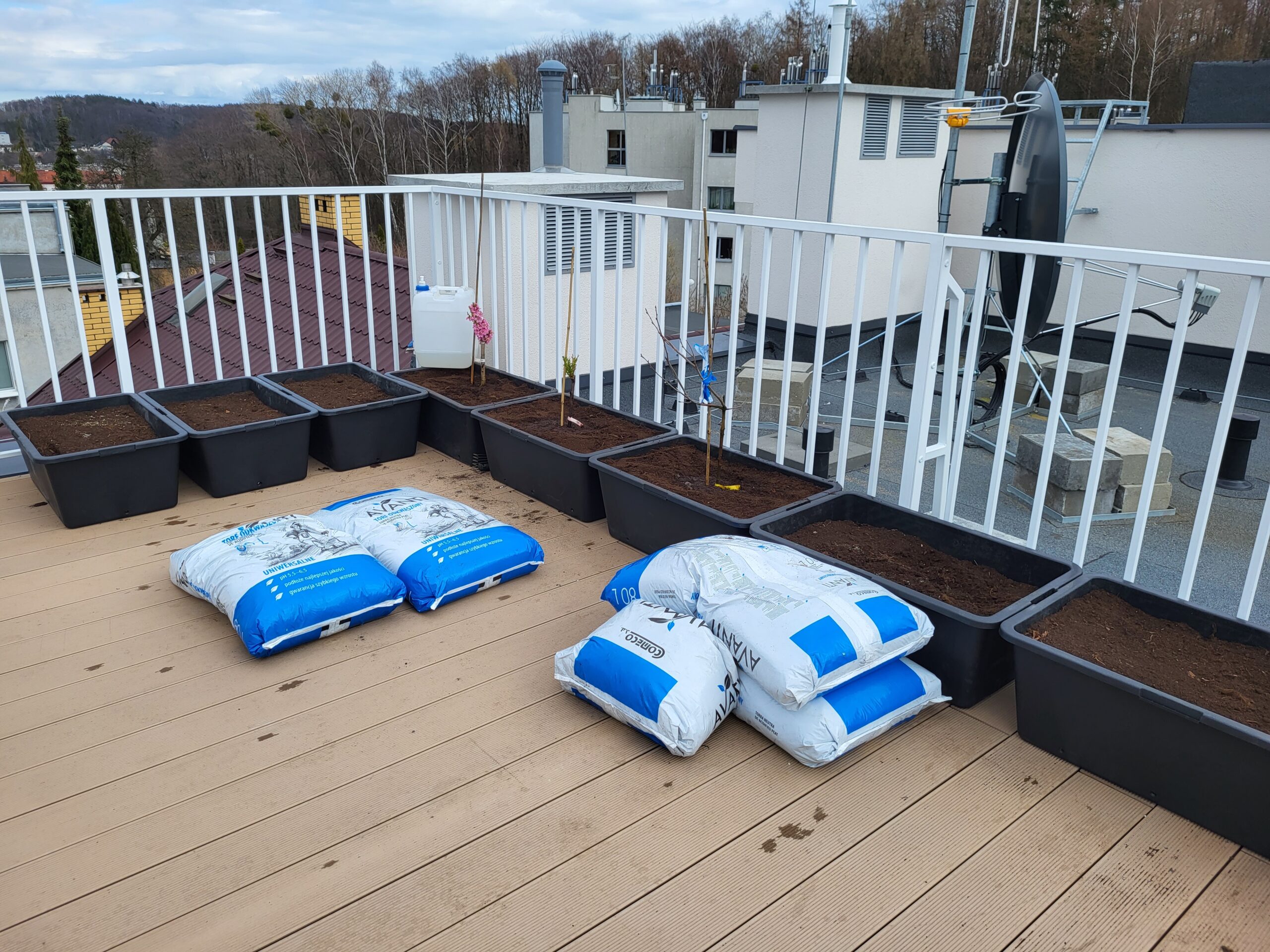
Preparing the rooftop garden with fresh potting soil before the growing season begins.
This photo shows one of the least glamorous stages of balcony gardening.
Bags of soil everywhere.
But this stage matters.
Large containers require a surprising amount of growing medium, especially when you use containers of around 80 liters.
Before buying soil, estimate how many containers you need to fill.
It is very easy to underestimate the amount.
What Should Good Container Soil Be Like?
Good container soil should not feel like wet clay.
It should be loose enough for roots to grow through it easily.
When you take a handful, it should have structure but should not form a hard, solid lump.
The ideal mix balances two things that may seem contradictory:
it needs to hold water, but it also needs to drain well.
If it drains too quickly, plants dry out constantly.
If it stays wet for too long, roots can suffer from a lack of oxygen.
The goal is balance.
Look at the Structure, Not Just the Color
Beginners often judge soil by how dark it looks.
Dark soil may look rich and fertile.
But color alone tells you very little about how it will behave in a container.
Structure is much more important.
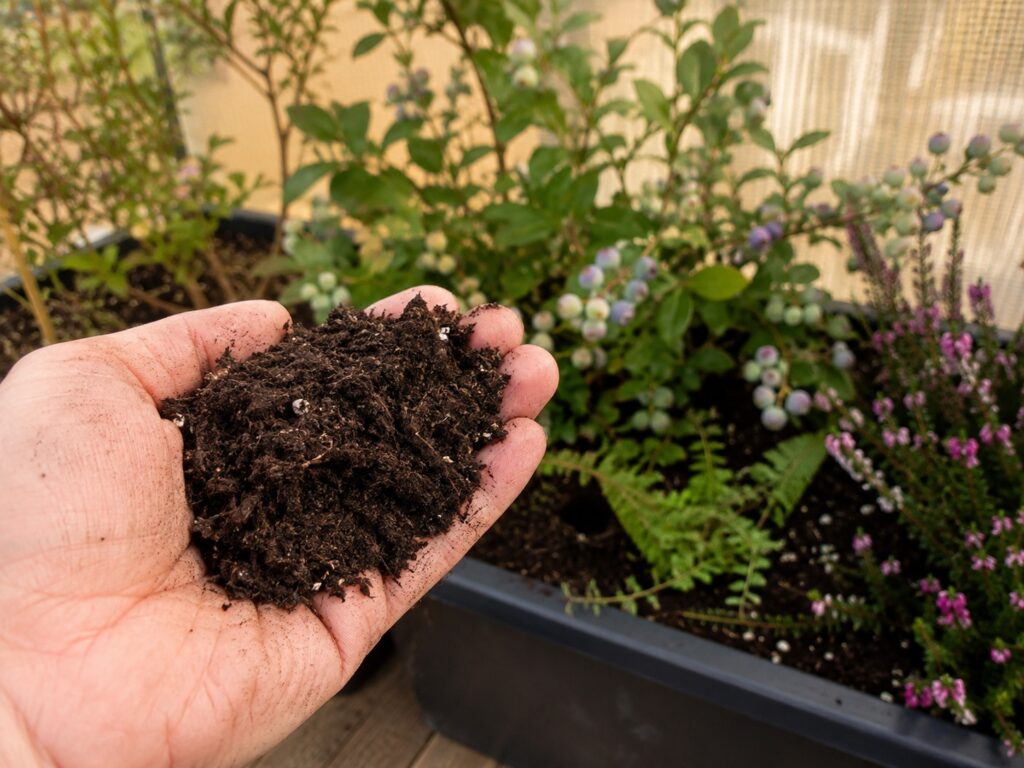
Good container soil should be loose, open, and easy for roots to grow through.
A useful potting mix often contains visible pieces of organic material and other ingredients that help prevent it from becoming compacted.
When you squeeze slightly moist potting mix in your hand, it should not behave like modelling clay.
It should break apart easily.
This loose structure creates small air spaces around the roots.
Roots need oxygen as well as water.
Why Container Soil Needs Good Drainage
Water behaves differently in containers than it does in open ground.
In a garden bed, excess water can continue moving deeper into the soil.
In a pot or tub, it eventually reaches the bottom of the container.
That is why good drainage depends on two things:
- the container must have drainage holes,
- the growing medium must allow water to move through it.
A perfect potting mix cannot compensate for a sealed container.
And excellent drainage holes cannot completely compensate for soil that has become dense and compacted.
The two must work together.
If you have not already read it, see my guide:
Best Containers for Balcony Gardening: Size, Drainage, and Materials
That article explains how I prepare the large containers used in my rooftop garden.
Do Not Compress the Soil Too Much
When filling a container, it is tempting to push the soil down firmly.
After all, you want to fit as much as possible inside.
But compacting the soil too strongly removes many of the air spaces that roots need.
I fill my containers gradually and settle the soil gently.
After watering, the level usually drops naturally.
You can then add more mix if necessary.
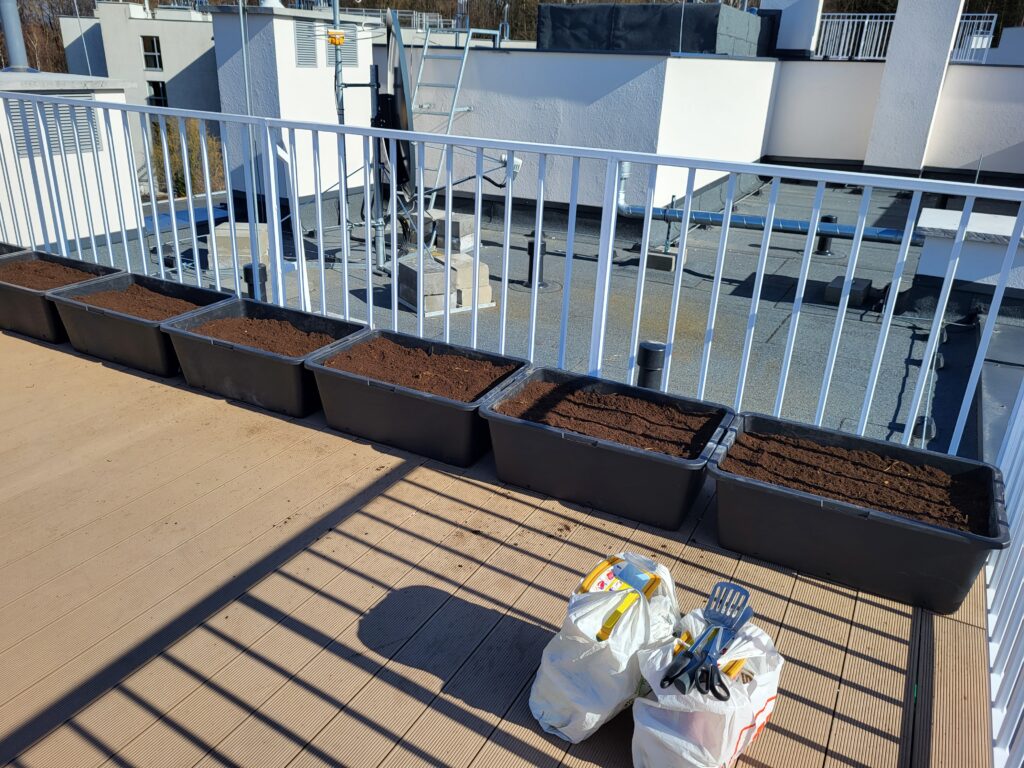
Large containers filled with fresh potting mix and ready for planting.
This is also why I do not fill containers completely to the top.
Leaving some space below the rim makes watering easier.
Otherwise, water and soil can run over the edge every time you water.
How Much Space Should You Leave at the Top?
You do not need to measure this with a ruler.
A few centimeters of space below the rim is usually enough.
The goal is simple:
when you water, the container should temporarily hold the water long enough for it to soak into the soil instead of immediately flowing over the sides.
Large containers make this easier.
They provide more soil volume and a larger water reserve around the roots.
A Simple Soil Mix Is Usually Enough for Beginners
You will find many complicated container soil recipes online.
Some include six, eight, or even ten ingredients.
That can make balcony gardening look much more difficult than it really is.
For a beginner, I would keep it simple.
Start with:
a good-quality universal potting mix designed for containers.
Then modify it only when there is a clear reason.
Depending on the plant and the mix you buy, useful additions can include:
- compost,
- perlite,
- bark,
- expanded clay,
- specialized acidic soil.
You do not need all of them in every container.
The plant should determine what you add.
Perlite Can Help Keep the Mix Light
Perlite is the small white material often visible in commercial potting mixes.
It is very lightweight.
Its main advantage is that it helps keep the growing medium open and reduces compaction.
This can improve:
- aeration,
- drainage,
- root development.
If the potting mix already contains enough light structural material, you may not need to add more.
The goal is not to follow a recipe blindly.
Look at the soil you already have.
Compost Adds Organic Matter and Nutrients
Compost can be a useful addition to container soil.
It contributes:
- organic matter,
- nutrients,
- biological activity.
But more is not always better.
A container filled entirely with rich compost may retain too much moisture or contain more nutrients than some plants need.
I prefer using compost as part of the growing medium rather than automatically treating it as the whole growing medium.
Again, balance matters.
Fresh Soil Settles After Watering
When you first fill a container, the surface may appear high and loose.
After watering several times, the soil settles.
That is normal.
You may need to add a little more potting mix around newly planted plants.
Do not be surprised if a freshly filled 80-liter container seems to “lose” soil after the first few waterings.
Nothing mysterious is happening.
Air spaces are settling and the material is finding its natural level.
Soil Changes During the Season
Potting mix does not remain exactly the same forever.
During the growing season:
- roots expand,
- organic matter decomposes,
- watering moves fine particles,
- nutrients are used by plants,
- the soil slowly settles.
This is especially noticeable in containers used for several years.
That does not mean all the soil needs to be replaced every season.
For established perennial plants, I often refresh the upper layer and add new growing medium or compost when necessary.
For annual vegetables, you can renew the growing medium more thoroughly between seasons.
Match the Soil to the Plant
One of the most important lessons in container gardening is this:
there is no single perfect soil for every plant.
A general potting mix is a useful starting point.
But some plants have special requirements.
This is especially important with plants that prefer acidic soil.
Blueberries Need Acidic Soil
Blueberries are a perfect example.
They do not thrive in the same soil conditions as many common vegetables and herbs.
They prefer distinctly acidic growing conditions.
That is why I grow blueberries with plants that have similar soil requirements.
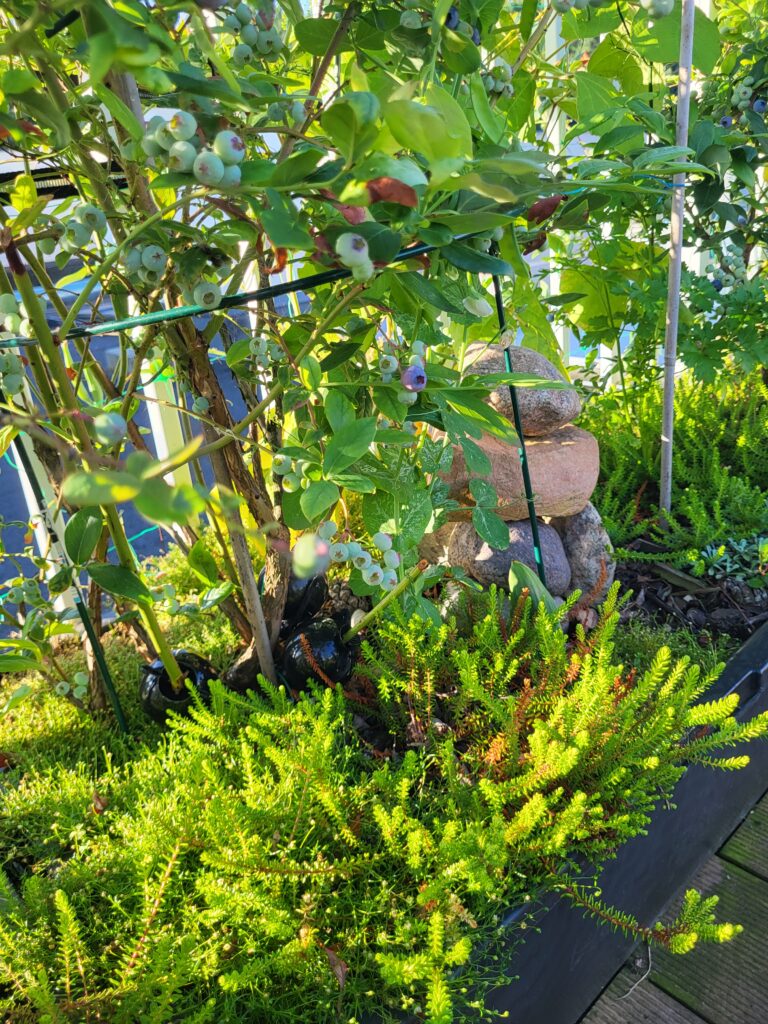
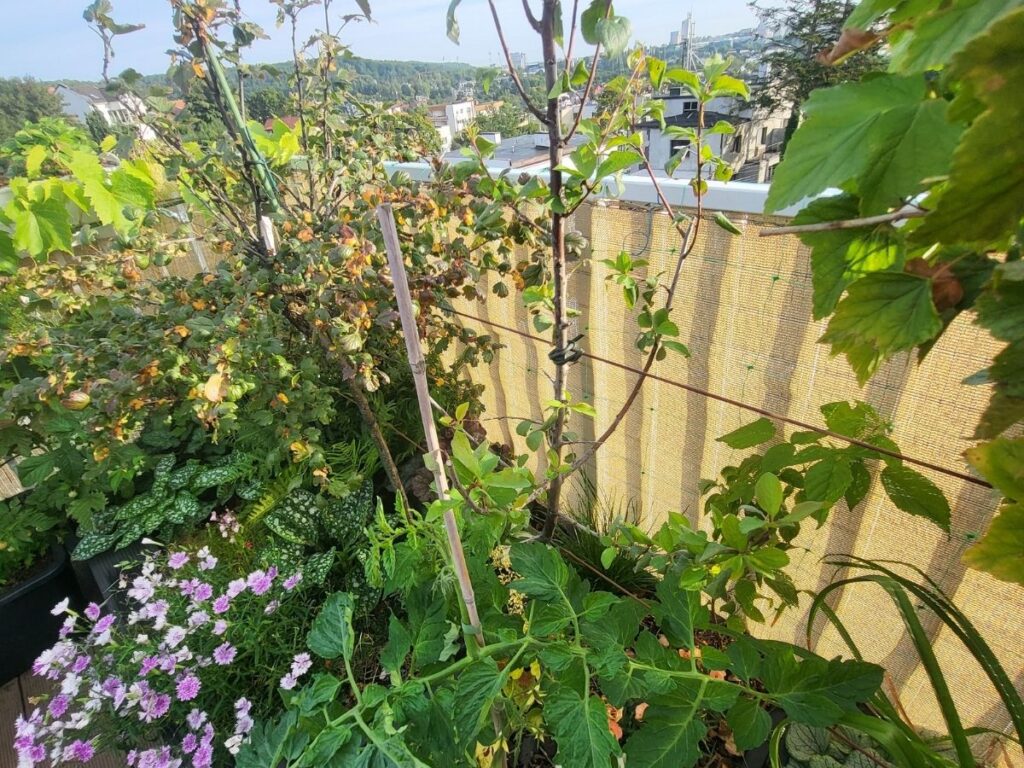
Blueberries grow best in acidic soil. In this container, the blueberry grows together with other acid-loving plants.
This is a useful principle when you want to combine several plants in one large container.
Do not combine plants only because they look good together.
Also check whether they need similar:
- soil,
- moisture,
- sunlight,
- feeding.
Plants sharing the same container must also share the same root environment.
Do Not Mix Acid-Loving Plants With Everything Else
Suppose you have one large container and want to plant a blueberry, parsley, lavender, and tomato together.
They may fit physically.
But that does not mean they are good companions.
The blueberry has different soil requirements.
It makes much more sense to group it with other acid-loving plants.
This makes maintenance easier because you are not trying to create two different soil conditions inside one container.
Vegetables Usually Prefer Rich, Productive Soil
Vegetables such as:
- tomatoes,
- peppers,
- cucumbers,
- leafy greens,
grow quickly and produce a lot of leaves or fruit.
They therefore need a productive growing medium and regular access to nutrients.
A fresh high-quality vegetable potting mix can be a good choice.
A good universal potting mix can also work, especially when supplemented appropriately during the growing season.
Soil alone does not have to contain enough nutrition for the entire season.
Container plants often need additional feeding later.
We will cover fertilizing separately because that deserves its own guide.
Herbs Do Not All Want the Same Soil
The word “herbs” covers plants with very different needs.
Parsley and chives appreciate reasonably fertile soil and regular moisture.
Mediterranean herbs such as thyme prefer conditions that are more free-draining.
That is another reason why one universal formula cannot be perfect for everything.
For beginners, however, you do not need to create laboratory-precise mixtures.
Observe the plant.
If the soil remains soaking wet for days, something is wrong.
If it becomes completely dry a few hours after watering, something may also need adjustment.
Large Containers Give You More Stability
One major advantage of large containers is the amount of soil they contain.
More soil means:
- more moisture reserve,
- more nutrients available to roots,
- slower temperature changes,
- more room for root development.
That is one reason I use large construction tubs extensively in my rooftop garden.
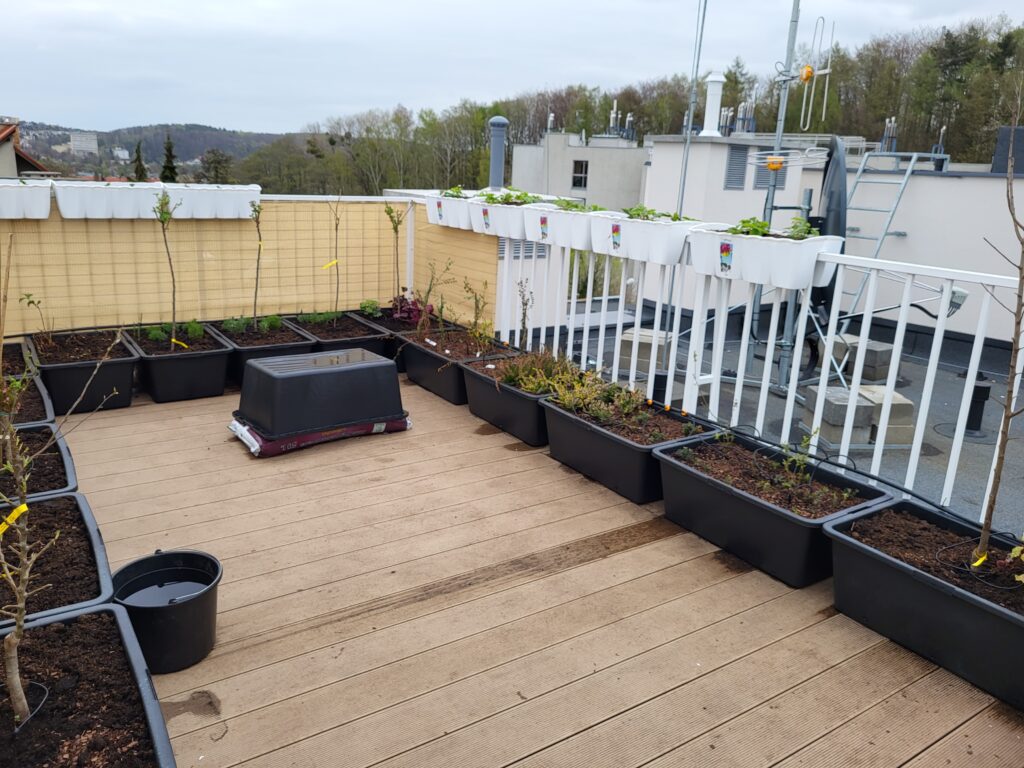
Once the containers are filled and planted, the soil becomes the foundation of the entire garden.
Small containers can certainly work.
But they are less forgiving.
A few hours of hot sun can dry a very small pot surprisingly quickly.
Large soil volume gives beginners more margin for error.
Protect the Soil Surface
Bare soil loses water through evaporation.
In some of my large containers, the soil surface gradually becomes covered by:
- low-growing plants,
- organic material,
- natural plant debris.
This can reduce direct exposure to sun and wind.
Mulching can also help conserve moisture.
However, avoid creating a permanently wet, airless layer around plant stems.
As with most things in container gardening, the goal is moderation.
Reusing Potting Soil
You do not always have to throw away all the soil after one season.
Healthy potting soil can often be reused.
Before reusing it:
- remove old roots where practical,
- check for pests or disease,
- loosen compacted areas,
- add fresh potting mix,
- add compost if appropriate,
- restore nutrients.
If a plant suffered from a serious soil-borne disease, replacing the growing medium may be safer.
For healthy containers, refreshing the soil is often sufficient.
Old Soil Needs New Nutrition
One thing beginners sometimes overlook is that reused soil is not the same as fresh soil.
Plants remove nutrients from it.
Watering also gradually washes some nutrients away.
The soil may still have excellent physical structure while containing much less nutrition than before.
That is why old container soil usually needs to be refreshed.
Different Plants Can Share the Same Base Mix
Despite all these differences, you do not need twenty bags of twenty different soils.
In practice, I use a general base for many plants and make changes where necessary.
A practical system is:
General plants
Good-quality universal potting mix.
Vegetables
Nutritious potting mix with good moisture retention and drainage.
Herbs
General mix, adjusted for the specific herb if necessary.
Blueberries and other acid-loving plants
Specialized acidic potting mix.
Long-term shrubs and fruit plants
Stable, well-structured mix suitable for multi-year container growing.
This keeps the garden manageable.
From Fresh Soil to a Growing Garden
The real test of any soil mix is not how impressive the bag looks.
It is how the plants grow in it.
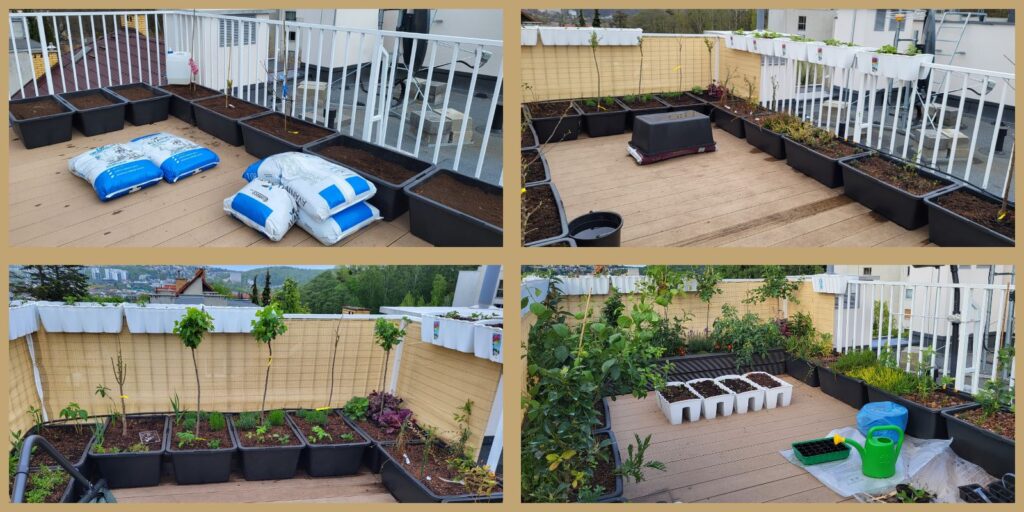
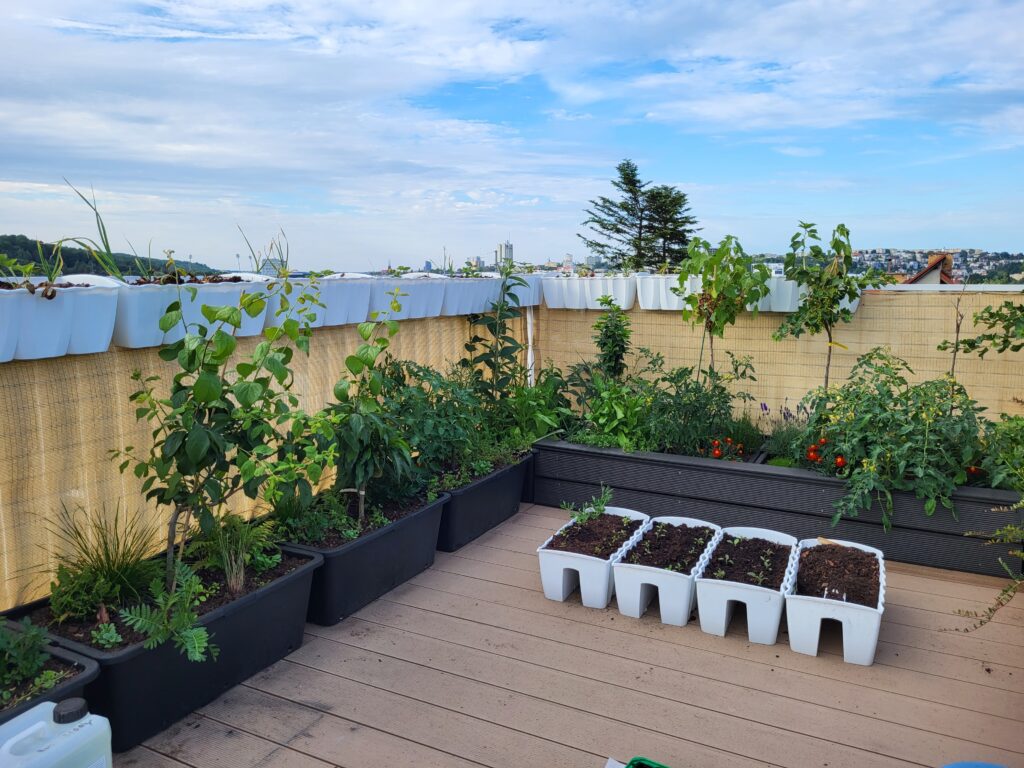
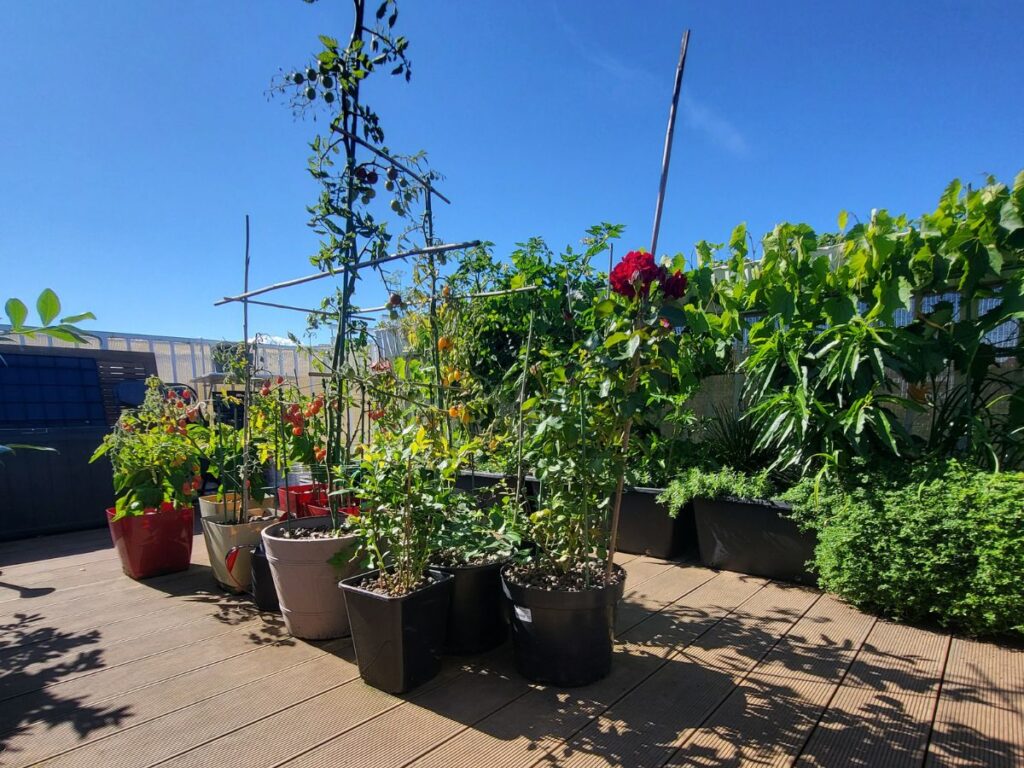
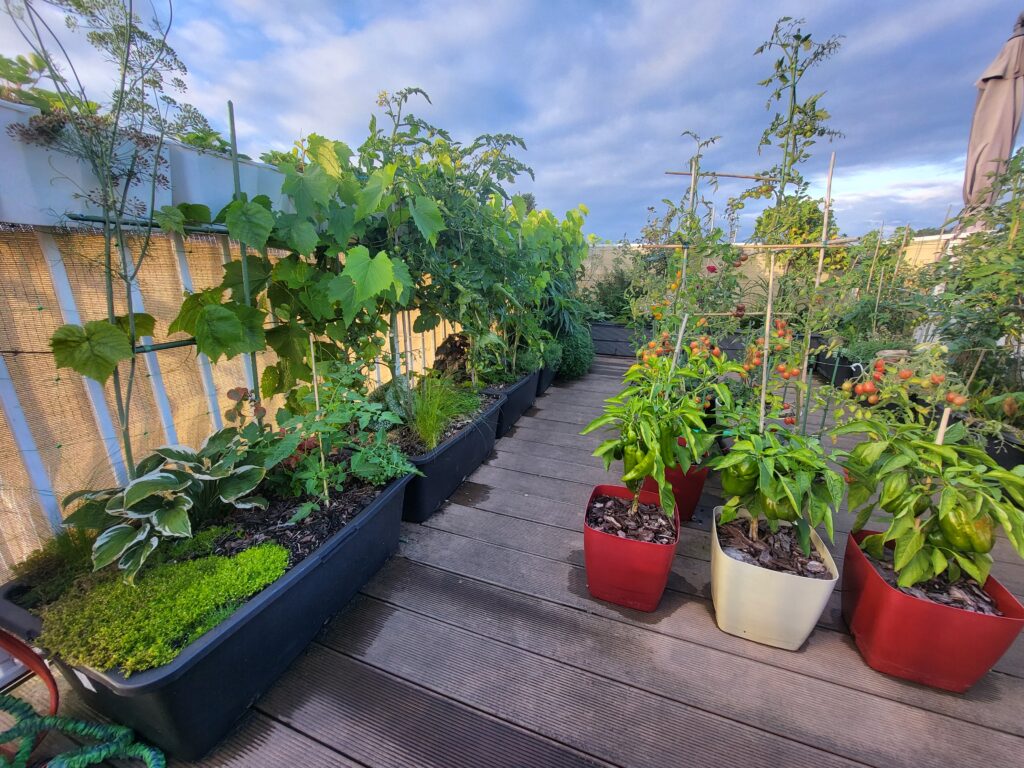
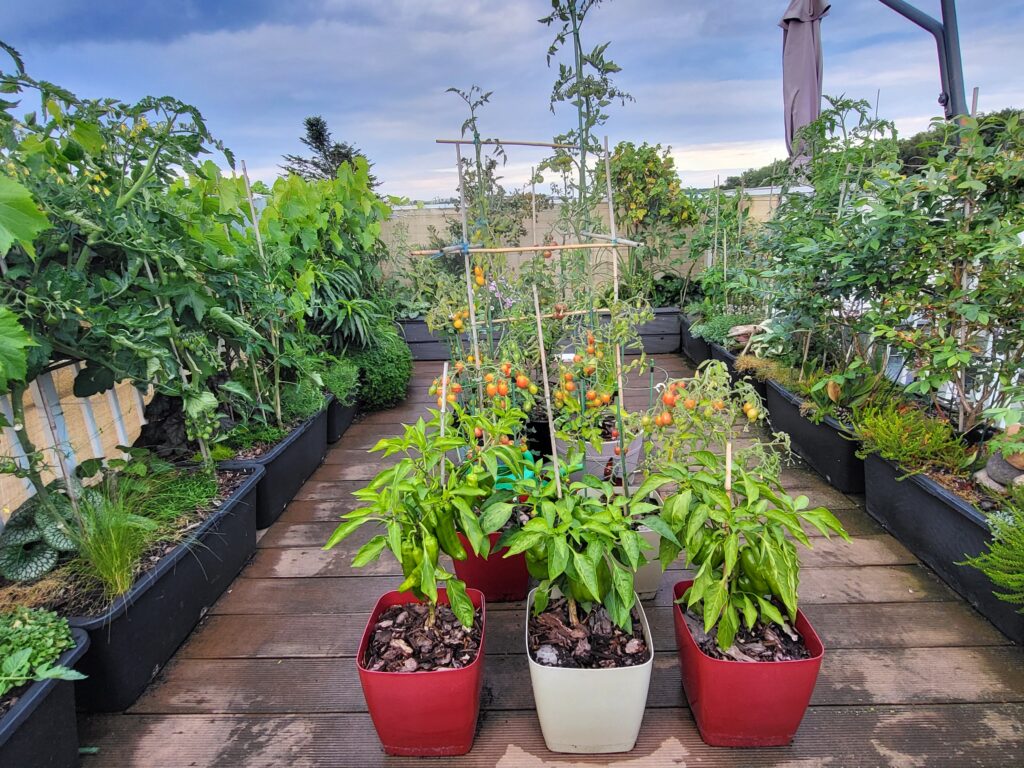
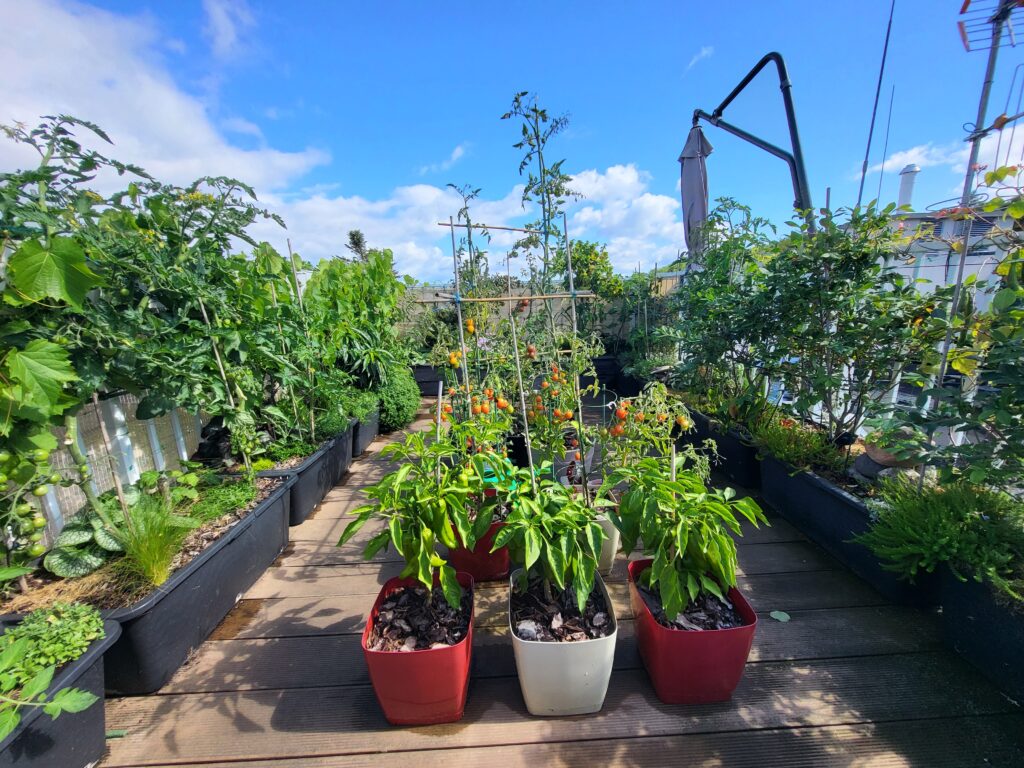
From fresh soil and empty containers to an established rooftop garden — the growing medium is where the process begins.
This sequence shows why soil preparation matters.
At the beginning of the season, most of what you see is containers and soil.
A few months later, the containers can almost disappear behind healthy plants.
That is the result we are aiming for.
Common Soil Mistakes Beginners Should Avoid
1. Filling pots with heavy garden soil
It may become dense and poorly drained inside containers.
2. Buying the cheapest soil without checking its structure
Cheap soil is not automatically bad.
Expensive soil is not automatically good.
Look at what you are actually getting.
3. Compacting the soil too firmly
Roots need air.
Do not turn your container into a brick.
4. Using the same soil for every plant
Blueberries are the obvious example of why this does not always work.
5. Forgetting that soil settles
Leave room to add more after watering if necessary.
6. Using old soil without refreshing it
Physical structure and nutrient content are two different things.
7. Focusing only on fertilizer
Good nutrition cannot fix badly compacted, waterlogged soil.
The root environment comes first.
A Simple Soil Checklist for Beginners
Before planting, ask:
- Is the soil designed for container growing?
- Does it feel loose rather than dense?
- Does it hold some moisture without becoming waterlogged?
- Can excess water drain through it?
- Is it suitable for the plant I want to grow?
- Does this plant require acidic soil?
- Is the container deep and large enough for the roots?
- Have I left some watering space below the rim?
If you can answer these questions, you are already avoiding many common beginner mistakes.
My Practical Rule
For most balcony plants, I would rather start with a simple, good-quality potting mix than build an unnecessarily complicated homemade recipe.
Then I adjust it when the plant gives me a reason.
Blueberries get acidic soil.
Plants that need better drainage get a lighter mix.
Hungry vegetables receive more nutrition.
That approach is simple, flexible, and much easier for a beginner to manage.
What Comes Next?
Once you have:
- checked your sunlight,
- chosen your containers,
- and prepared the soil,
the next essential skill is watering.
Container plants depend on you much more than plants growing in open ground.
Too little water causes obvious problems.
Too much water can be just as damaging.
In the next guide, I will explain:
How to Water a Balcony Garden Properly
If you are building your garden from the beginning, you may also want to read:
How to Start a Balcony Garden: A Beginner’s Step-by-Step Guide
https://gardenabovethecity.com/how-to-start-a-balcony-garden/
How Much Sun Does a Balcony Garden Need?
https://gardenabovethecity.com/how-much-sun-does-a-balcony-garden-need/
Best Containers for Balcony Gardening: Size, Drainage, and Materials
https://gardenabovethecity.com/best-containers-for-balcony-gardening/
Want the Complete Step-by-Step Guide?
Balcony & Rooftop Gardening for Beginners
A Practical Guide to Containers, Soil, Watering, and Starting Your First Garden
The book goes deeper into planning your space, choosing containers, preparing soil, watering correctly, dealing with rooftop conditions, setting up different types of small-space gardens, and caring for your plants during their crucial first weeks.
Digital edition · PDF + EPUB · Instant download · $14.99
Interested in reading future Garden Above the City books early?
Join the Reader Team for occasional opportunities to read selected books and resources before or around publication.