Best Containers for Balcony Gardening: Size, Drainage, and Materials
Choosing plants is exciting.
Choosing containers usually seems much less important.
But after growing vegetables, fruits, herbs, and ornamental plants on my rooftop terrace and balcony for years, I have learned that the container can make a huge difference.
A plant in a container that is too small, dries out too quickly, or has poor drainage can become a constant problem.
The same plant in a well-prepared container can be surprisingly easy to grow.
For beginners, there are three things that matter most:
- container size,
- drainage,
- material.
You do not need expensive designer pots.
You need containers that give the roots enough space, allow excess water to escape, and work in the conditions of your balcony or rooftop.
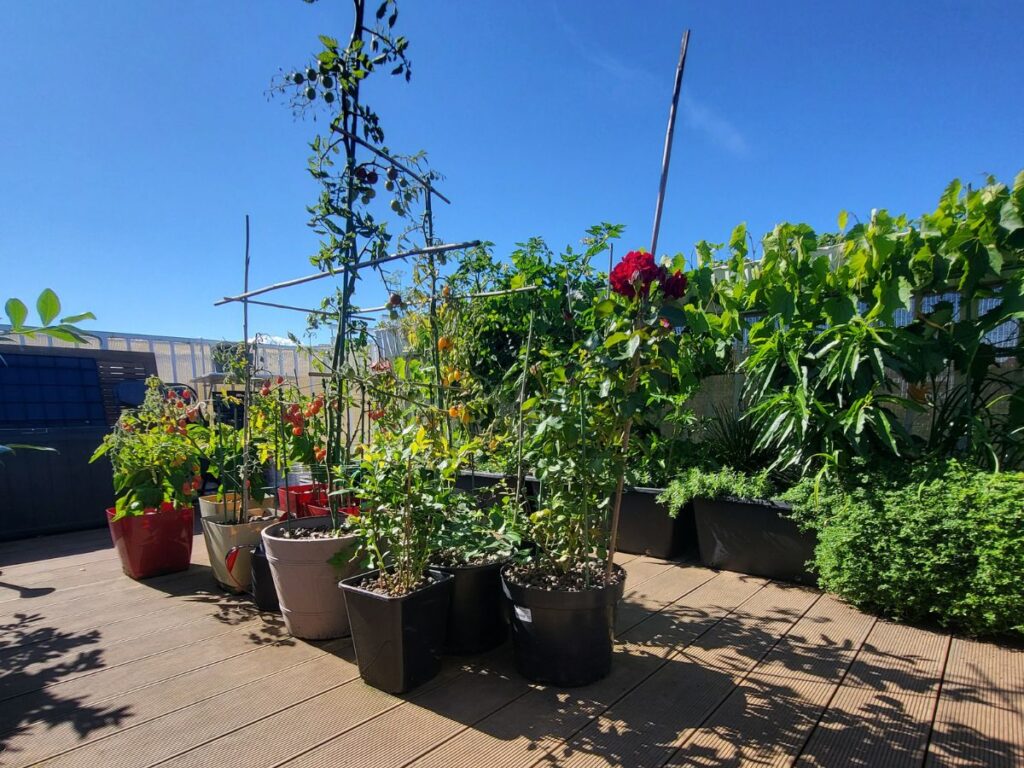
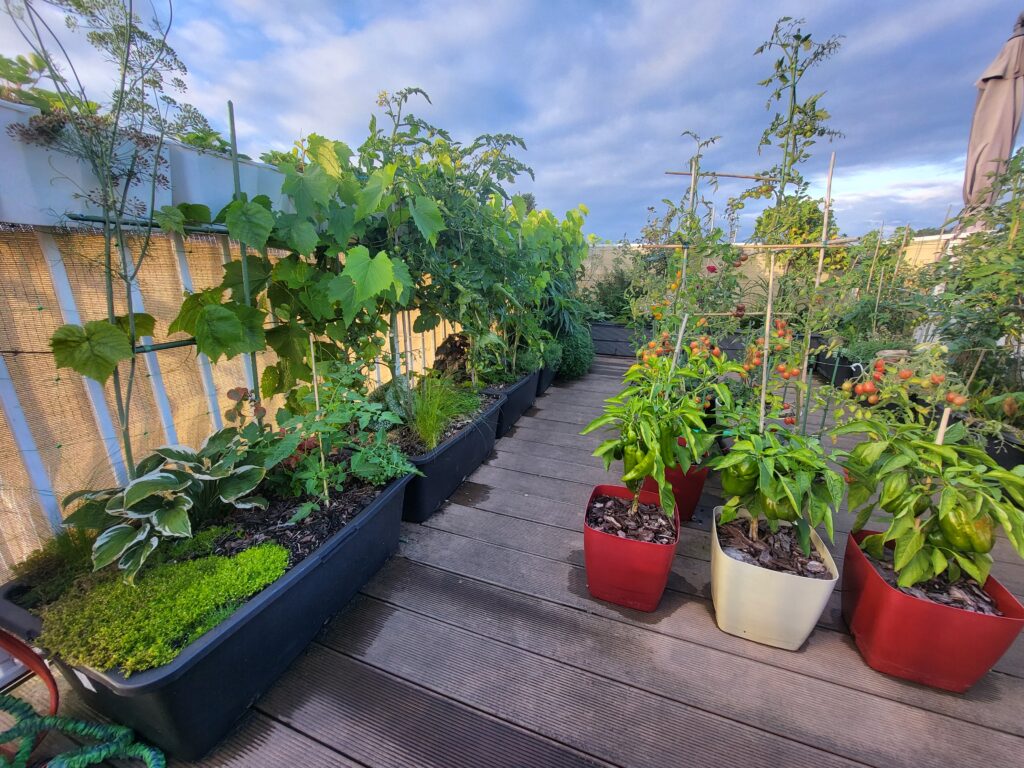
My rooftop garden in summer. Most of the larger plants grow in simple, large containers rather than expensive decorative pots.
Start With Your Balcony, Not the Container
Before buying containers, first look at the place where they will stand.
A balcony can be:
- sunny,
- shady,
- windy,
- sheltered,
- hot,
- cool,
- narrow,
- or surprisingly spacious.
A rooftop terrace can be even more demanding because it is often exposed to stronger sun and wind.
These conditions affect how containers perform.
A small dark pot placed in full summer sun may heat up and dry out very quickly.
The same container in partial shade may stay moist much longer.
Before choosing your containers, consider:
- how many hours of direct sun the area receives,
- how strong the wind can be,
- how much usable space you have,
- where excess water can drain,
- and how much weight the balcony or rooftop can safely support.
If you have not checked your sunlight yet, read How Much Sun Does a Balcony Garden Need?
It is one of the first things worth checking before choosing plants and containers.
Plan the Garden Before You Fill the Containers
Large containers look simple when they are empty.
The situation changes completely once they are filled with drainage material, soil, water, and plants.
They become heavy.
Very heavy.
That is why I prefer to decide where the largest containers will stand before filling them.
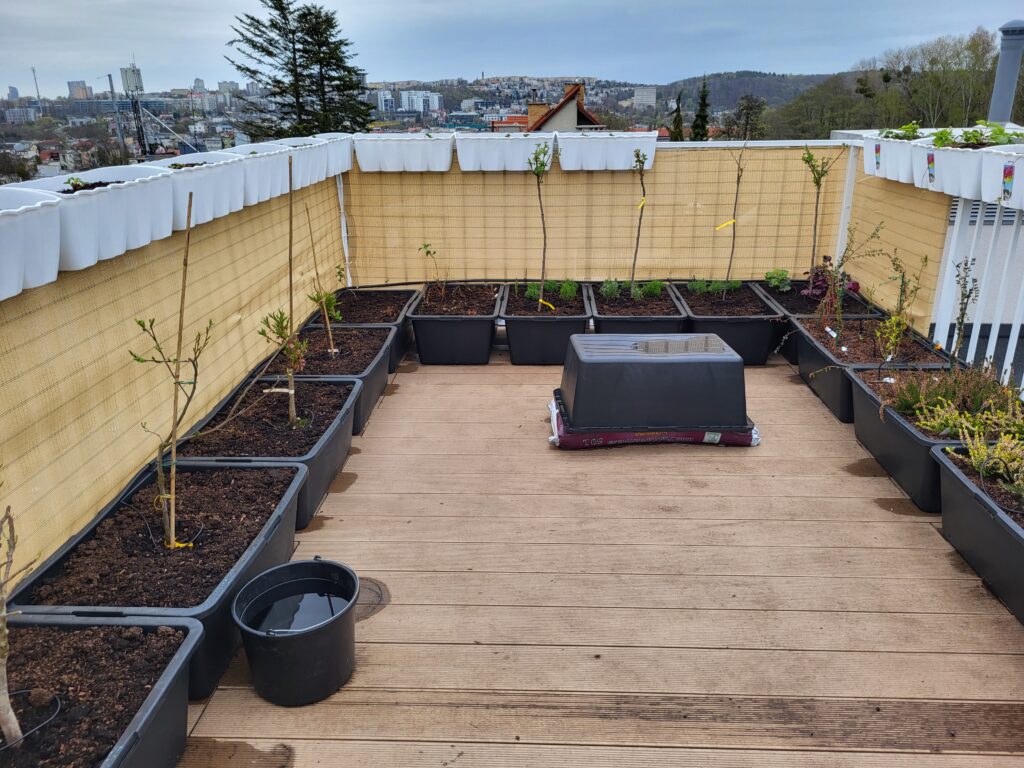
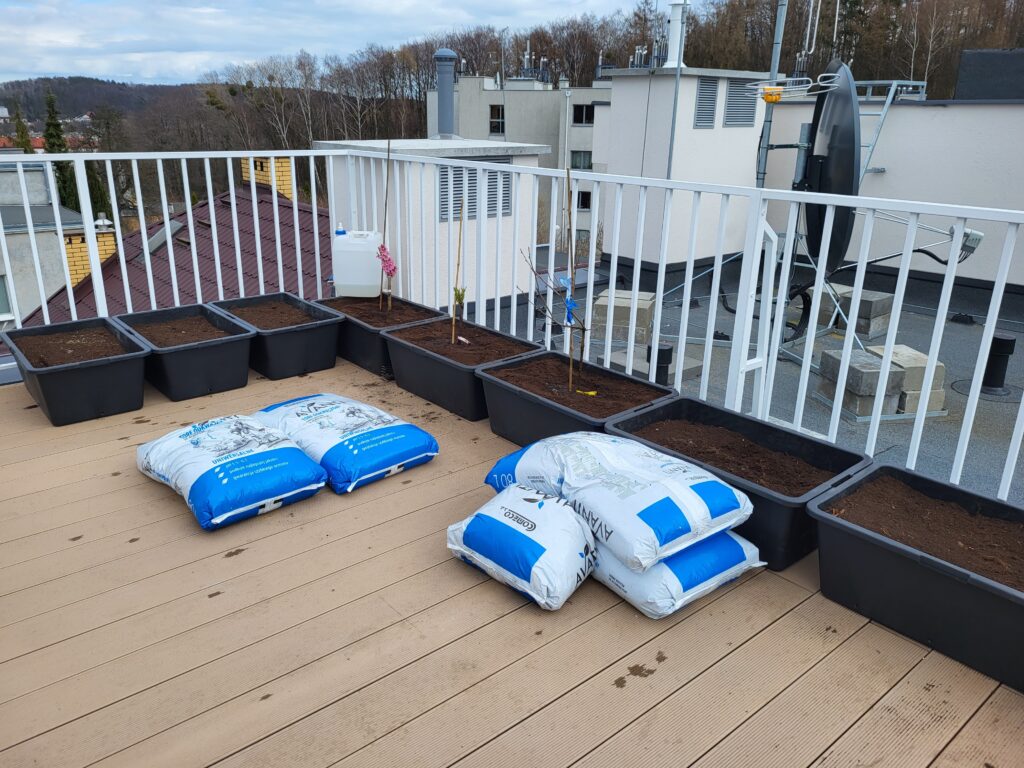
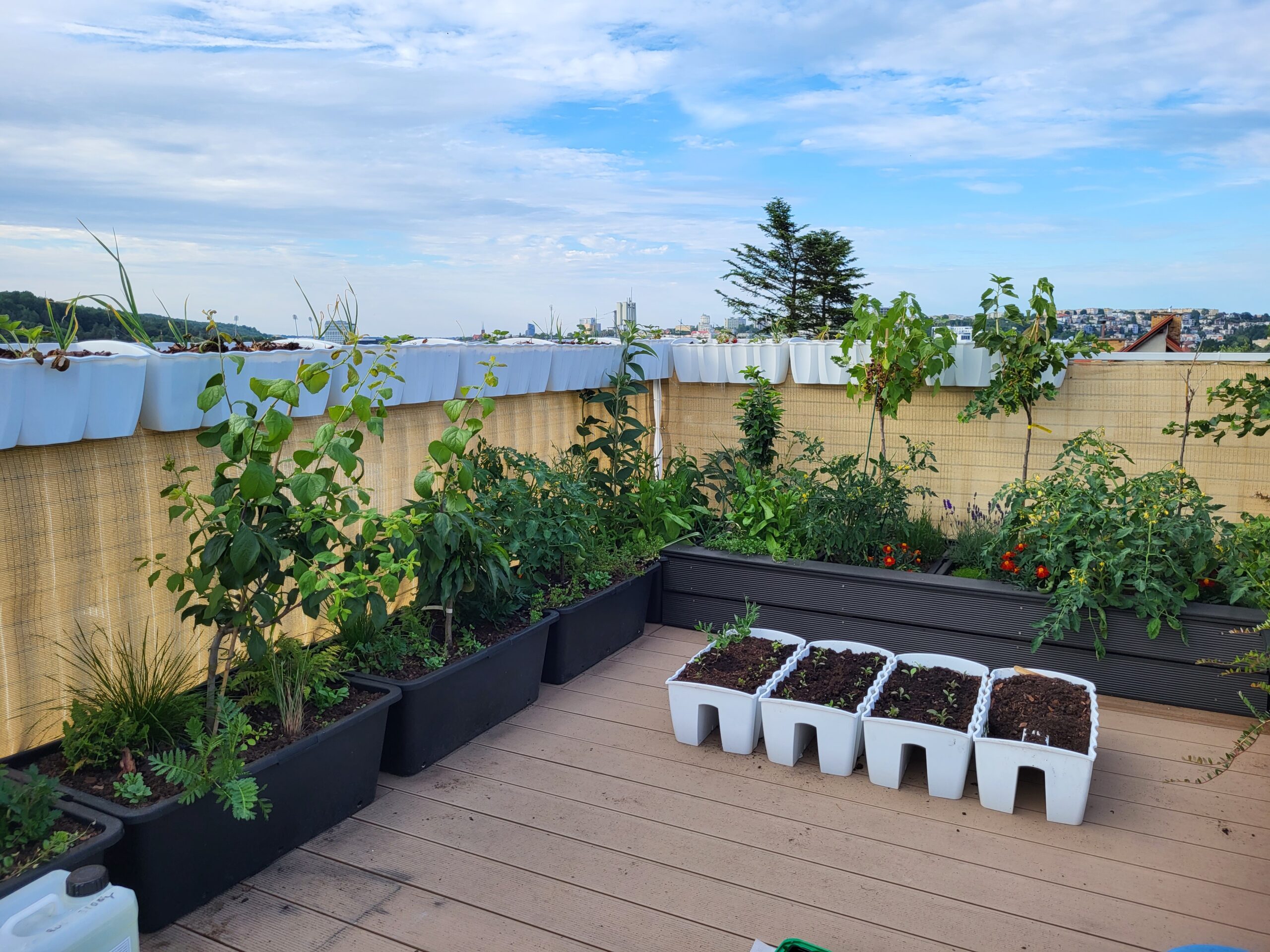
The rooftop garden at the beginning of the season. I position the large containers before they become too heavy to move easily.
This photo shows my rooftop garden early in the season.
The plants are still small, but the main structure of the garden is already in place.
The large containers stay close to the edges of the terrace, leaving enough space to walk and work between them.
Later in the season, those same containers become almost hidden by plants.
Container Size Matters More Than Most Beginners Expect
One of the most common beginner mistakes is using pots that are too small.
Small pots have obvious advantages.
They are:
- inexpensive,
- light,
- easy to move,
- easy to fit into a small balcony.
But they also:
- hold less soil,
- dry out faster,
- heat up faster,
- give roots less space,
- and require more frequent watering.
A larger container creates a much more stable environment.
There is more soil around the roots, which means more stored water and fewer sudden changes in temperature.
This is particularly important for larger plants and plants that remain in the same container for several years.
Small Containers Have Their Place
Small pots are useful when they are used for the right plants.
They can work well for:
- thyme,
- parsley,
- chives,
- smaller herbs,
- strawberries,
- compact flowers,
- seedlings.
They are also useful when starting young plants before moving them into their permanent containers.
The mistake is not using small pots.
The mistake is putting a large plant into a pot that can never provide enough space for its root system.
Medium Containers Work for Many Balcony Plants
Medium-sized containers are useful for plants such as:
- peppers,
- herbs,
- lettuce,
- strawberries,
- compact tomatoes,
- annual flowers,
- smaller ornamental plants.
When deciding between two sizes, I usually prefer the larger one.
For beginners, a little extra soil creates a useful safety margin.
This becomes especially important during hot summer weather when small containers can dry out surprisingly fast.
Large Containers Make Growing Easier
Large containers are the foundation of my rooftop garden.
I use 80-liter construction tubs for many plants.
They were designed for construction work, not gardening.
That is exactly why they are interesting.
They are:
- strong,
- large,
- relatively inexpensive,
- easy to modify,
- practical.
With proper drainage, they work very well as growing containers.
[PHOTO 14]
ALT: Large 80-liter construction tubs used for growing plants on a rooftop terrace
Caption: Large construction tubs are the main growing containers in my rooftop garden.
I use large containers for plants including:
- currants,
- gooseberries,
- blueberries,
- raspberries,
- grapes,
- peaches,
- pears,
- tomatoes,
- climbing plants,
- ornamental shrubs and perennials.
A large soil volume helps keep conditions around the roots more stable.
That makes watering easier and gives plants much more room to develop.
One Container Can Become a Small Garden
A large container does not always have to hold just one plant.
Some of my containers contain several plants growing together.
This allows me to create a small mixed planting instead of treating each container as a separate flowerpot.
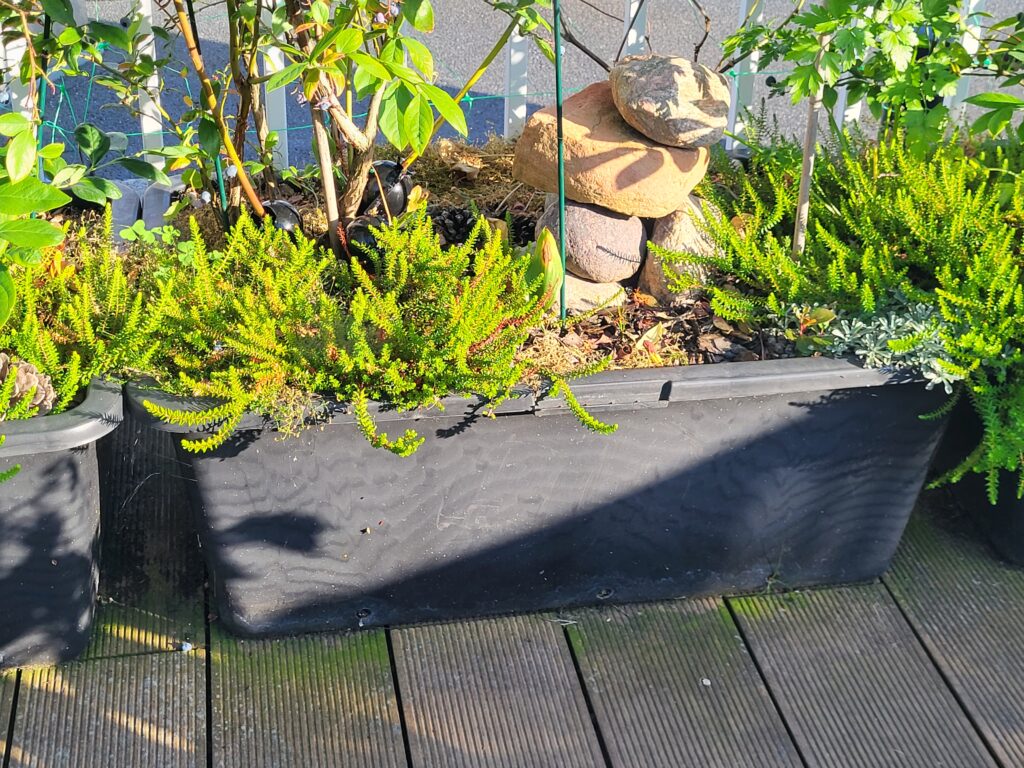
A large construction tub can become a small garden of its own.
With enough space, a large container can hold a taller main plant together with lower-growing plants around it.
This also makes large black containers less visually dominant because the plants gradually cover the sides and edges.
Drainage Is Essential
No matter how large or expensive the container is, poor drainage can cause problems.
Roots need both water and air.
If excess water cannot escape, the growing medium can remain waterlogged for too long.
That is why I prepare drainage before adding soil.
For my large construction tubs, I make several drainage holes close to the bottom.
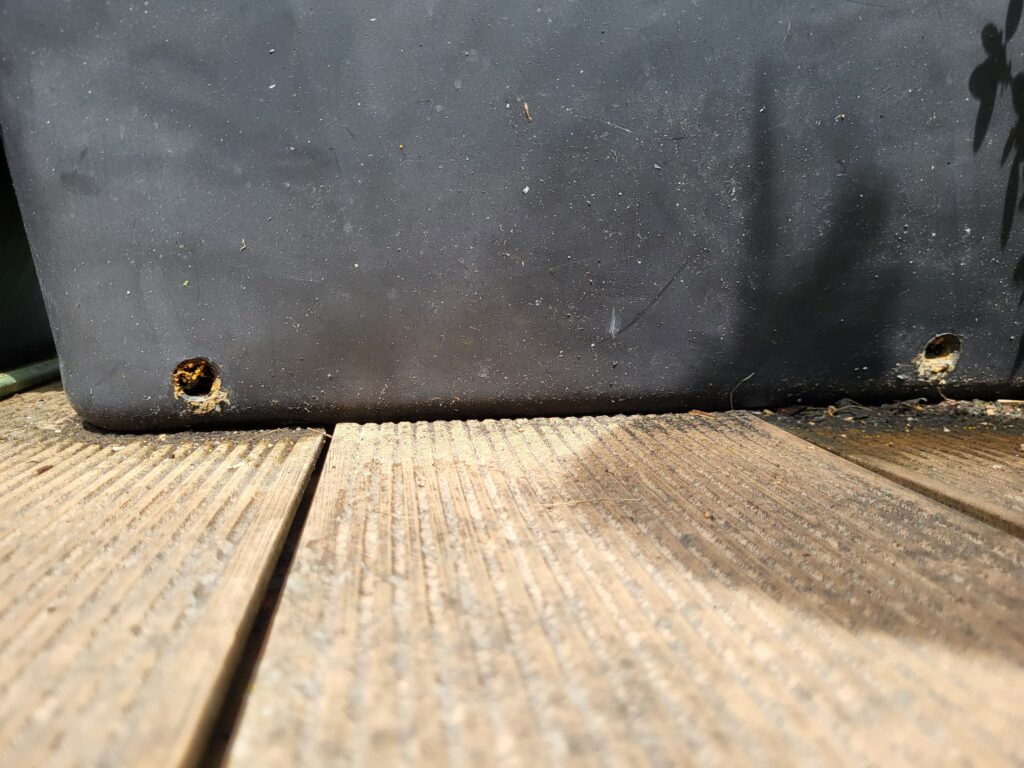
Drainage holes near the bottom allow excess water to leave the container.
I place the holes low enough to remove excess water, but because they are in the side wall rather than directly underneath the container, the drainage remains easy to observe and is less likely to be completely blocked by the terrace surface.
The exact system can vary depending on the container, but the principle is simple:
excess water must have a reliable way out.
How I Prepare the Bottom of My Containers
In my large containers, I also use a layer of lightweight expanded clay aggregate at the bottom.
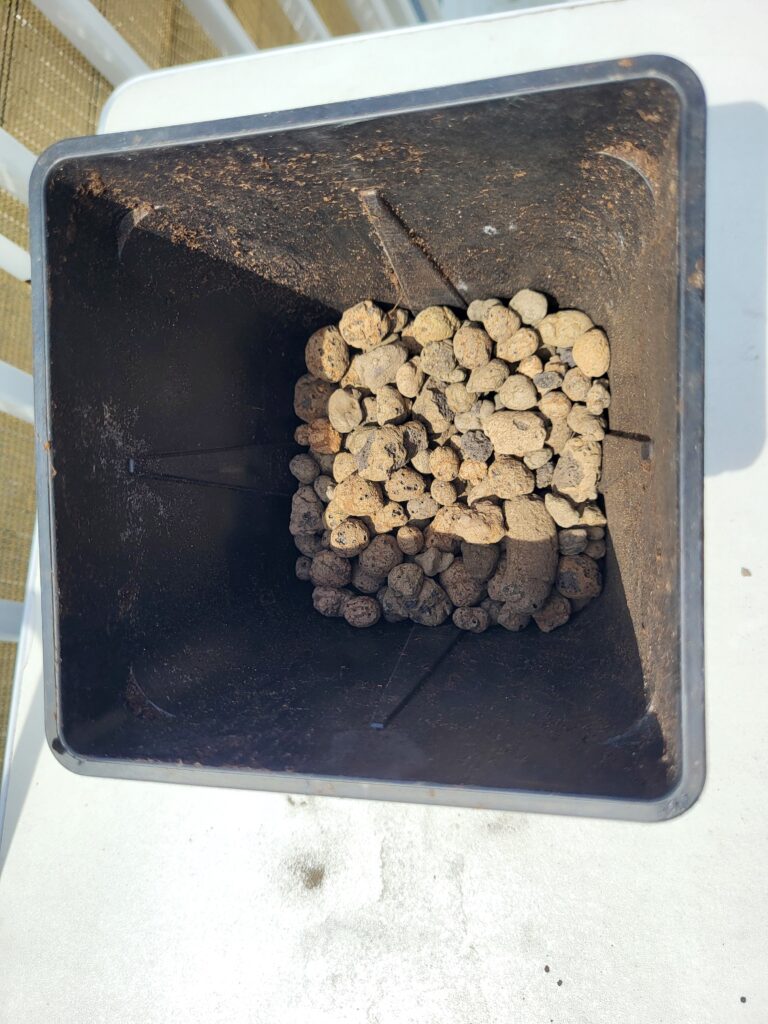
A layer of lightweight expanded clay at the bottom of one of my containers before the soil is added.
This is part of the system I use on my terrace.
The drainage holes allow excess water to escape, while the lightweight material at the bottom helps keep the drainage zone open.
There are different approaches to preparing containers, and not every gardener uses a separate drainage layer.
What matters most is that the container has reliable drainage and that the growing medium does not remain permanently waterlogged.
For my large tubs, this system has worked well.
Bigger Containers Are Easier — But Much Heavier
There is an important trade-off.
The larger the container, the easier it can be to maintain stable moisture.
But the heavier it becomes.
An 80-liter container filled with growing medium, water, and a mature plant is not something you casually move around the terrace.
Before filling a large container, decide where you want it to stay.
This matters even more on balconies.
Always consider the weight your balcony or rooftop structure is designed to support.
If you are unsure about the load capacity, check the building documentation or ask a qualified professional.
Do not guess.
Different Plants Need Different Containers
There is no single best pot size for every balcony plant.
The container should match the mature plant.
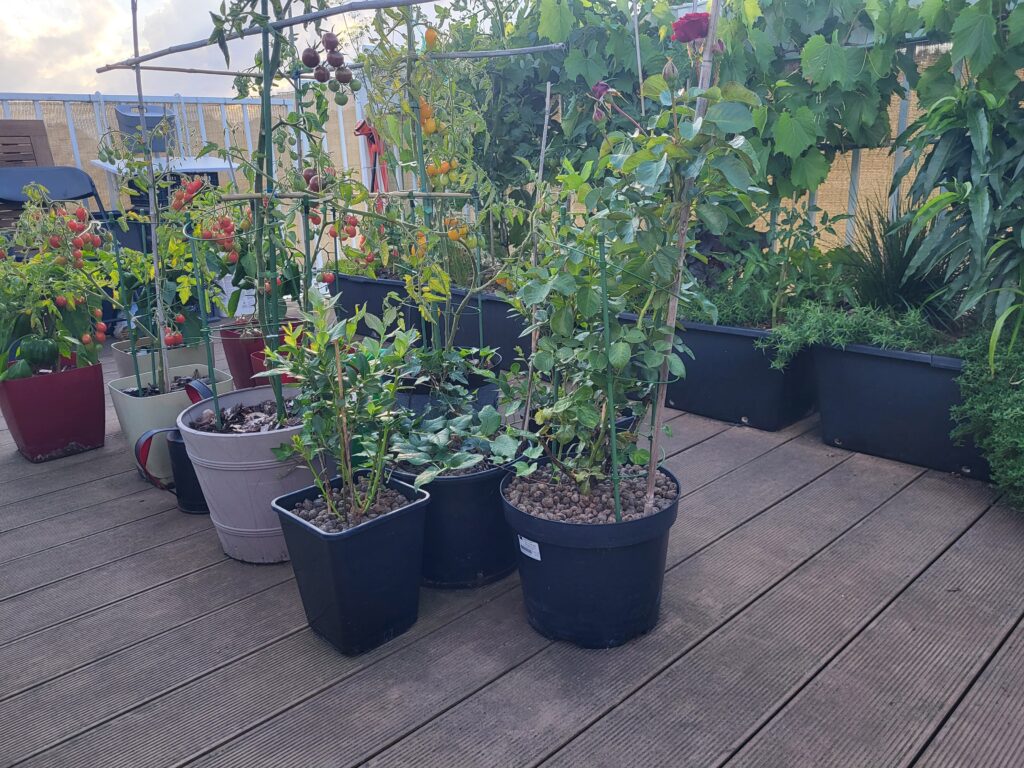
Different plants need different amounts of root space, so I use several container sizes.
This is an important point for beginners.
When you buy a young plant, it may look tiny.
But you should choose the container based on what that plant will become, not only what it looks like on the day you buy it.
Herbs
Many herbs can grow successfully in smaller containers.
For example:
- thyme,
- chives,
- parsley,
- dill,
- basil.
Some perennial herbs can stay in the same container for several seasons and benefit from additional root space.
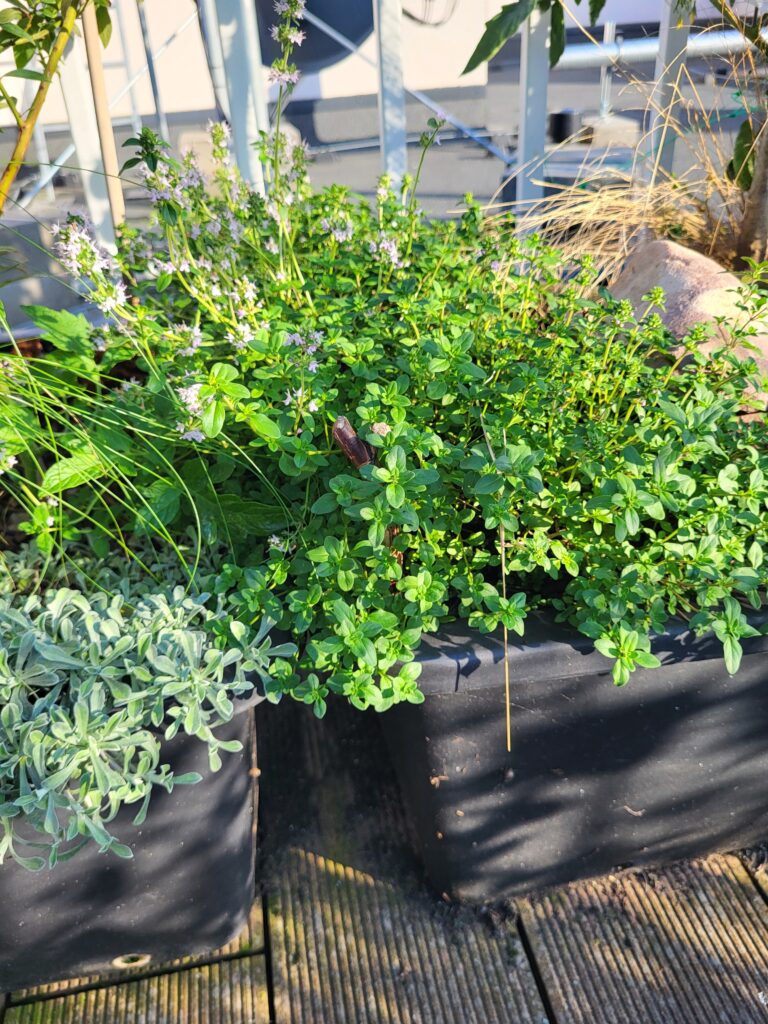
Herbs do not always need huge containers, but they still need enough soil and reliable drainage.
For herbs, I also like combining plants rather than automatically giving every herb its own pot.
It saves space and creates a more natural-looking planting.
Tomatoes
Tomatoes need more space than many beginners expect.
Larger tomato varieties produce substantial root systems and use a lot of water during summer.
A bigger container gives them:
- more soil,
- more available moisture,
- better stability,
- more room for roots.
It also makes daily watering less stressful during hot weather.
Trying to save space by using a very small tomato pot can create much more work later.
Peppers
Peppers can usually manage with less root space than large tomato plants.
Medium-sized containers can work well.
However, extremely small pots dry out quickly, especially on sunny balconies.
Again, a little extra volume usually makes life easier.
Strawberries
Strawberries are much easier to fit into small spaces.
They can grow in:
- pots,
- rectangular planters,
- railing containers,
- larger mixed containers.
Good drainage remains important.
Their smaller size also makes them useful for balconies where every square foot of space matters.
Berries
Berries need considerably more space if you want to keep them in containers for years.
Examples include:
- currants,
- gooseberries,
- blueberries,
- raspberries.
For these plants, I prefer large containers.
They provide a more stable root environment and reduce the need for constant repotting.
Small Fruit Trees
Fruit trees such as peaches and pears require large, stable containers.
You also need to think about more than root space.
Consider:
- mature size,
- wind,
- winter conditions,
- watering,
- stability.
A small tree becomes much larger and heavier after several seasons.
Plan for the future.
Plastic Containers
Plastic is one of the most practical materials for a beginner balcony garden.
Advantages include:
- low weight,
- low cost,
- wide availability,
- many sizes,
- relatively good moisture retention.
Plastic is also one reason construction tubs work so well for my own rooftop garden.
Disadvantages
Thin plastic can:
- become brittle,
- crack,
- deform,
- overheat in strong sunlight.
For long-term use, I prefer thick and sturdy containers.
Dark containers can become warm in direct sunlight, so this is another reason why sufficient soil volume helps.
Terracotta Pots
Terracotta has been used for growing plants for generations.
It looks natural and works particularly well for many herbs.
Because terracotta is porous, water can evaporate through the walls.
That can be useful for plants that dislike staying too wet.
But it also means the pot can dry out faster.
Advantages
- traditional appearance,
- good airflow,
- stable,
- suitable for many herbs.
Disadvantages
- heavy,
- fragile,
- dries out faster,
- may crack during freezing weather.
On a hot or windy balcony, terracotta may require more frequent watering.
Glazed Ceramic Pots
Glazed ceramic containers can be very attractive.
They generally lose less moisture through their sides than unglazed terracotta.
They are also heavy, which can be useful in windy places.
The disadvantages are equally obvious:
- price,
- weight,
- fragility.
Large ceramic containers can become extremely heavy when filled.
Always check that they have proper drainage.
Some decorative ceramic containers are designed as pot covers and have no drainage holes.
Wooden Planters
Wooden containers can work very well for balcony gardens.
They can hold substantial amounts of soil and offer good insulation around the root zone.
They are useful for:
- vegetables,
- herbs,
- flowers,
- mixed plantings.
The main issue is durability.
Wood is constantly exposed to moisture and weather.
Choose material suitable for outdoor use and make sure water can drain freely.
Fabric Grow Bags
Fabric grow bags are another practical option.
They are:
- light,
- easy to store,
- relatively inexpensive,
- available in large sizes.
They can work well for seasonal vegetables.
However, breathable sides also allow water to evaporate faster.
On a sunny rooftop, this can mean more frequent watering.
Metal Containers
Metal containers can look very attractive.
But they can heat up quickly in direct sunlight.
That heat can transfer to the soil around the roots.
For decorative use they can be excellent.
For large plants on a very hot balcony, I would use them more carefully.
Self-Watering Containers
Self-watering containers can be helpful if you cannot check plants several times a day during hot weather.
They usually contain a reservoir that supplies water to the growing medium.
They can reduce watering frequency.
But they are not completely automatic.
You still need to:
- monitor the reservoir,
- observe the plant,
- adjust watering to the weather,
- prevent excessive moisture.
They are a tool, not a replacement for checking your garden.
Container Shape Also Matters
Volume and drainage are more important than shape, but shape still affects how practical a container is.
Wide containers provide more planting surface.
Deep containers provide more root volume.
Long rectangular tubs are particularly useful along walls and railings.
Tall, narrow pots can look elegant but may become unstable in strong wind.
On a rooftop, I prefer containers with a wide, stable base.
Wind Changes the Rules
Wind is one of the biggest differences between gardening at ground level and gardening several floors above it.
Strong wind can:
- dry the soil,
- damage leaves,
- break stems,
- move lightweight pots,
- overturn tall containers.
Large, heavy containers are usually much more stable.
Grouping containers together can also create a more protected growing area.
I will cover wind protection in a separate guide because it deserves much more attention.
Think About Water Before Building a Large Container Garden
A few pots are easy to water.
A rooftop garden with many large containers is different.
Before expanding your garden, think about:
- where the water comes from,
- how far you have to carry it,
- whether you can use a hose,
- where excess water will go,
- how quickly the containers dry,
- whether water can drip onto the balcony below.
The best container is not only the one that suits the plant.
It must also work with the way you maintain your garden.
Cheap Containers Can Work Very Well
One of the most useful lessons from my rooftop garden is that you do not need expensive garden pots to grow healthy plants.
The large construction tubs I use are a good example.
They were designed for a completely different purpose.
But after preparing them for gardening, they provide exactly what many large plants need:
- space,
- strength,
- soil volume,
- stability.
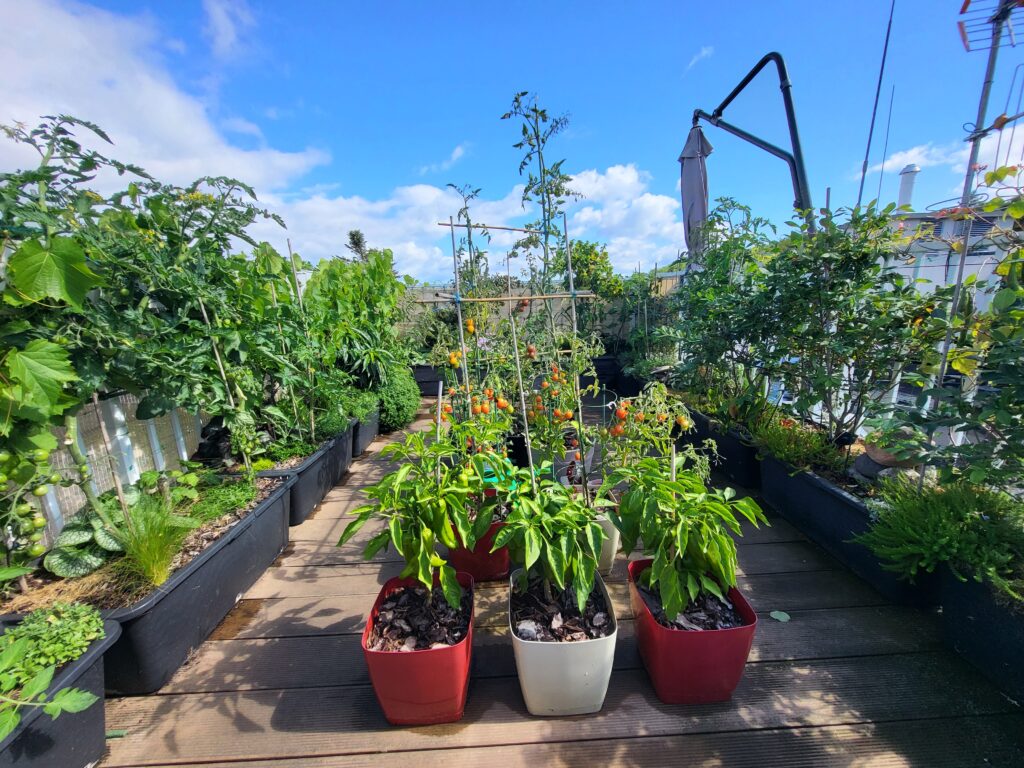
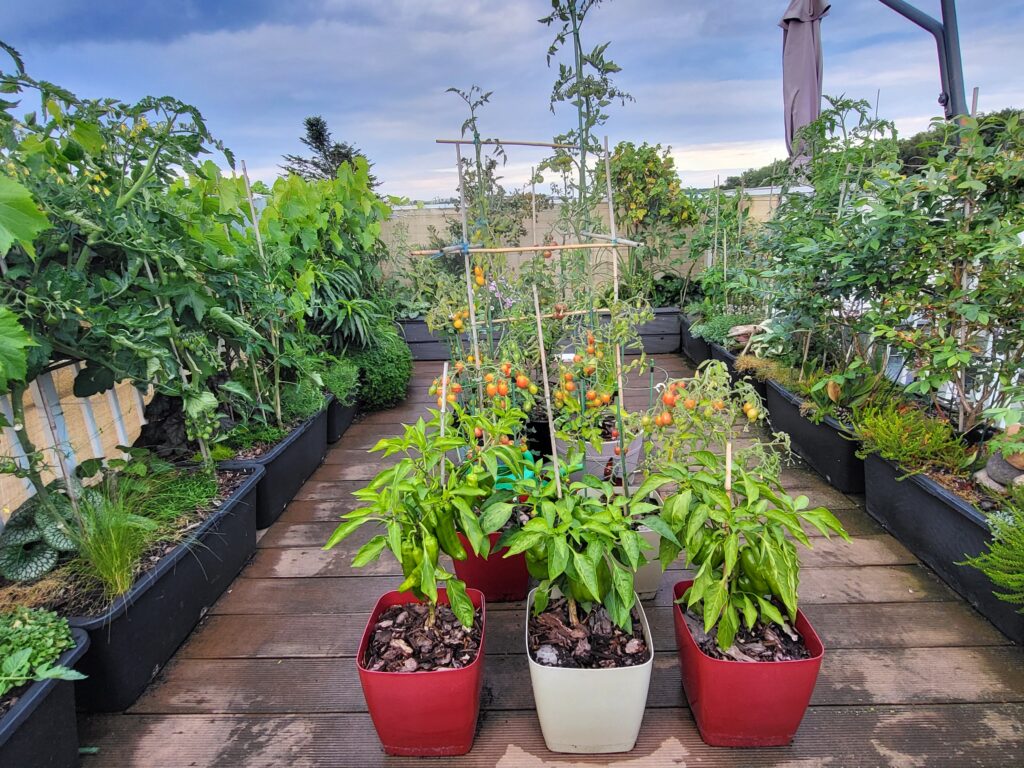
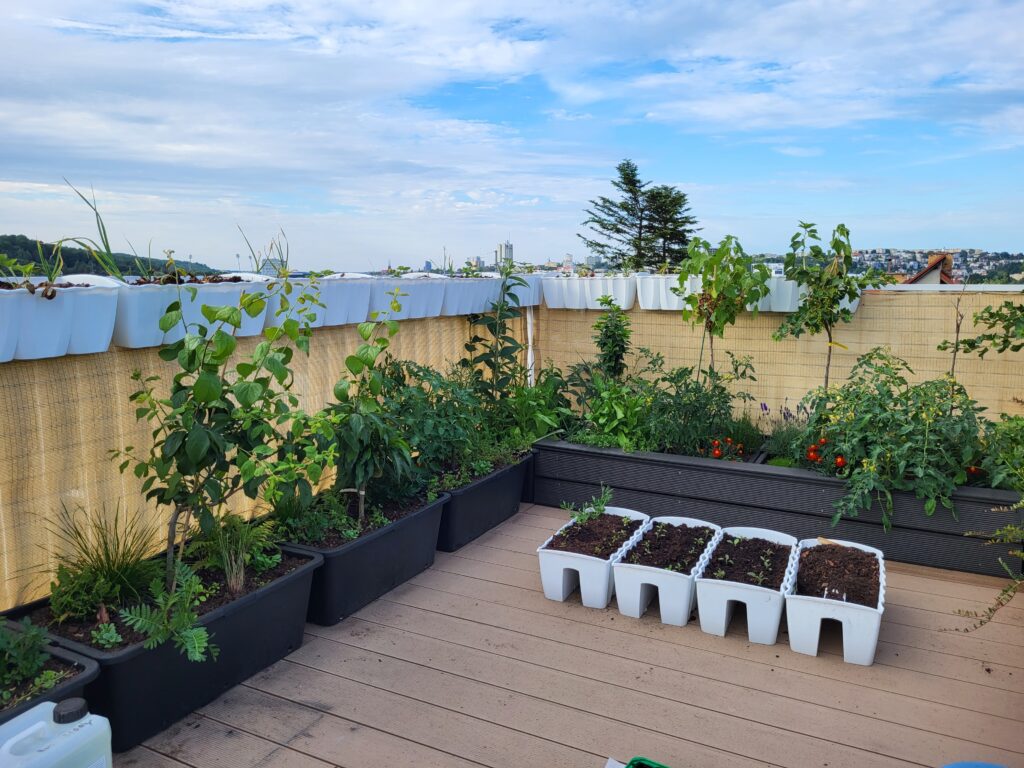
Compare the garden early in the season with the same space later.
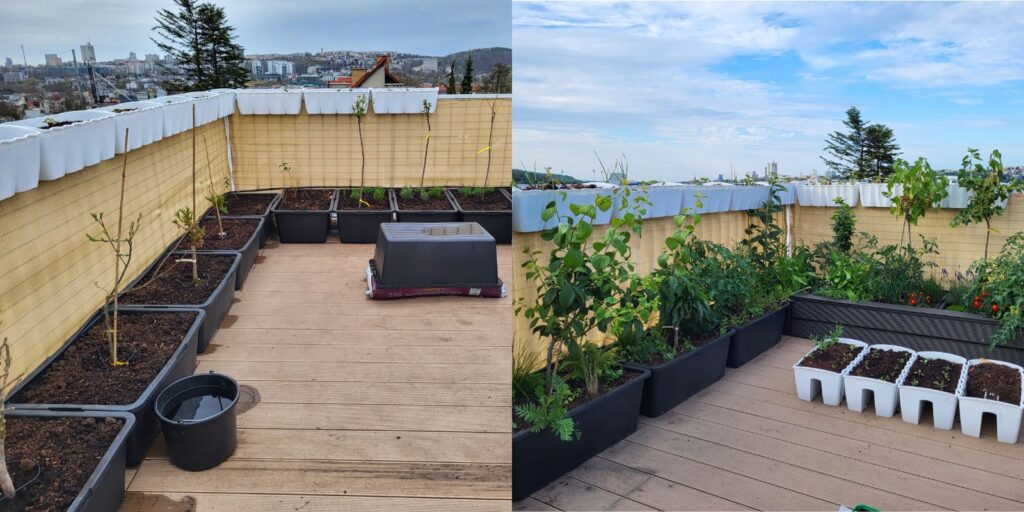
The containers themselves are not the star of the garden.
That is the point.
Once the plants mature, the containers become part of the background.
Common Container Mistakes Beginners Should Avoid
1. Choosing a pot only because it looks good
Roots do not care how expensive the container is.
Size and drainage matter more.
2. Using containers that are too small
This creates unnecessary watering problems.
3. Forgetting drainage
Every container must have a reliable way for excess water to escape.
4. Ignoring final weight
A large container may be easy to move when empty and almost impossible to move when full.
5. Using tall lightweight pots in strong wind
They can become unstable.
6. Buying every container before choosing the plants
It is usually better to know what you want to grow first.
7. Treating every plant the same way
Different plants have different root systems and water requirements.
A Simple Container Checklist for Beginners
Before buying or filling a container, ask:
- Is it large enough for the mature plant?
- Does it have good drainage?
- Can excess water escape safely?
- Will it be too heavy to move?
- Is it stable in wind?
- Will it become very hot in direct sun?
- Can I water it easily?
- Is it strong enough to last more than one season?
You do not need the perfect pot.
You need a container that works.
My Practical Rule
If I have to choose between a container that is slightly too large and one that is slightly too small, I usually choose the larger one.
It gives roots more space.
It holds more soil.
It stores more moisture.
It creates more stable growing conditions.
For a beginner, that extra margin can prevent many problems.
What Comes Next?
Once you have chosen the right containers, the next question is obvious:
What should you fill them with?
The growing medium is just as important as the container.
In the next guide, I will explain how to choose and prepare the best soil for balcony gardens and container plants.
If you are starting your garden from the beginning, you may also want to read:
How to Start a Balcony Garden: A Beginner’s Step-by-Step Guide
https://gardenabovethecity.com/how-to-start-a-balcony-garden/
and:
How Much Sun Does a Balcony Garden Need?
https://gardenabovethecity.com/how-much-sun-does-a-balcony-garden-need/
Want the Complete Step-by-Step Guide?
Balcony & Rooftop Gardening for Beginners
A Practical Guide to Containers, Soil, Watering, and Starting Your First Garden
The book goes deeper into planning your space, choosing containers, preparing soil, watering correctly, dealing with rooftop conditions, setting up different types of small-space gardens, and caring for your plants during their crucial first weeks.
Digital edition · PDF + EPUB · Instant download · $14.99
Interested in reading future Garden Above the City books early?
Join the Reader Team for occasional opportunities to read selected books and resources before or around publication.